

Last time I wrote about confidence routing: the system does the work it is sure about, holds what needs review, and escalates what it cannot resolve. That makes the agent safe to put in production. It also creates a new problem.
The work that gets routed does not resolve itself. Someone has to own the review queue, answer the questions, approve the consequential decisions, and remain accountable for the result. If those responsibilities are spread across a traditional services structure with a project manager, an engineering team and a QA team, you get a narrower version of the same pyramid. The volume moves faster, but judgment still moves through meetings and handoffs.
A forward-deployed pod is not a smaller consulting team supervising some AI tools. It is the control plane for a fleet of agents. Its job is to define what may run, what must be produced, where work must stop, and who has the authority to let it continue.
Once you take that seriously, the org chart becomes executable.
The executable org chart
A normal org chart tells you who reports to whom. An executable org chart tells the system how work is allowed to move.
Such a pod is best described as a graph.
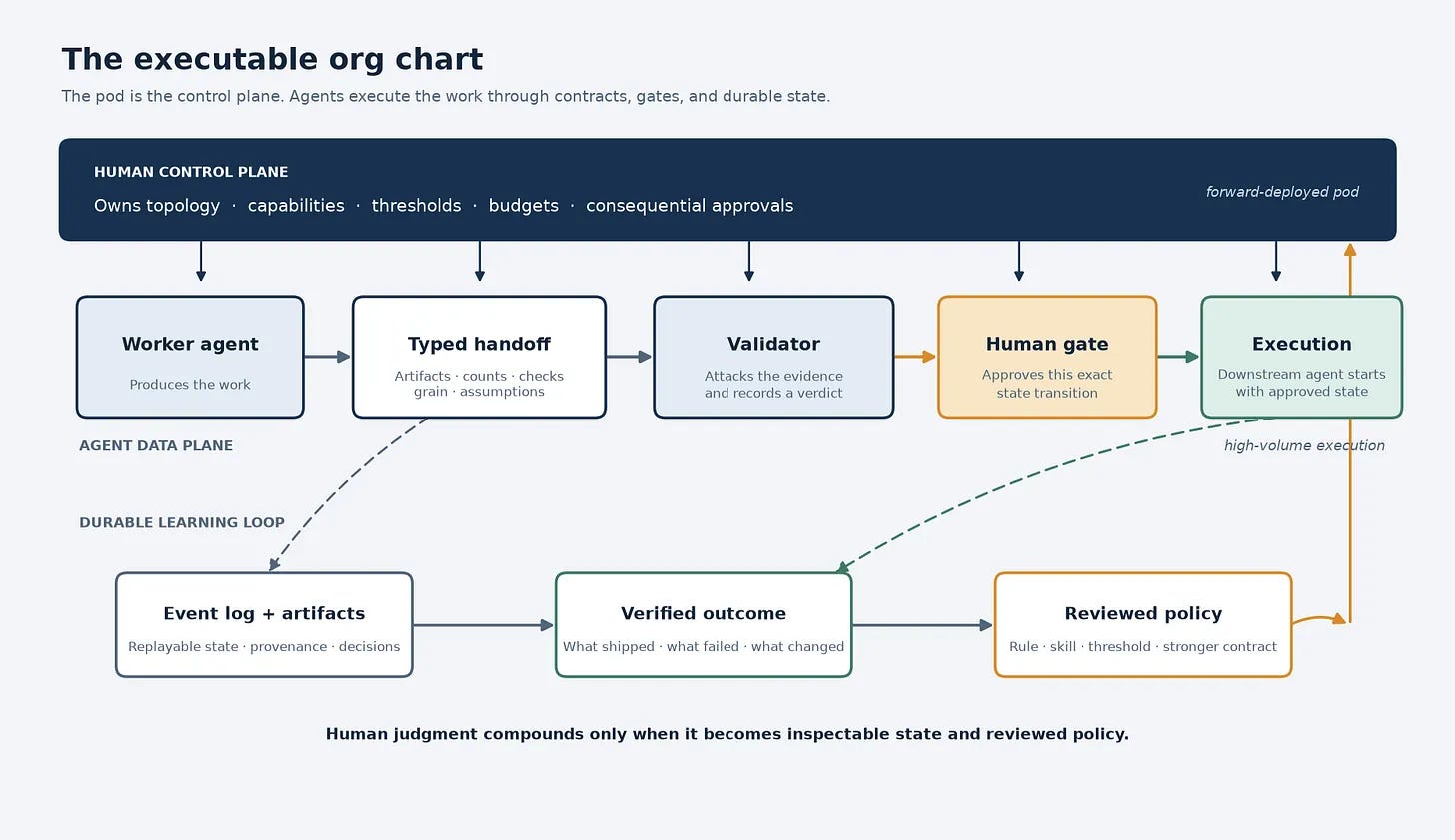
The nodes are agents. Each node has a role, a charter, a set of skills and tools, a runtime budget, the context it may read, and the other agents it is allowed to contact.
The edges are the working relationships between them: this agent hands work to that one, this validator checks this output, this orchestrator watches these stages. The edge also carries the conditions for moving forward. It can name the artifact that must be produced, the fields the next agent expects, the validator that must sign off, and whether a person has to approve the transition.
When a project starts, that description is materialized into isolated agent sessions and workspaces. Each agent receives its own instructions, tools, context, and operating policy. The runtime creates the event log, the handoff chain, the question queues, and the approval state. What looked like an org chart in configuration becomes the actual topology of delivery.
That distinction matters because a fleet of agents behaves less like a group of employees and more like a distributed system. Agents run concurrently, fail independently, resume from checkpoints, and produce state that other agents consume. Leave their boundaries implicit and you get the usual distributed-systems failures: hidden coupling, missing context, duplicate work, and no clear owner when the process stops.
The pod is the layer that makes those boundaries explicit.
Handoffs are APIs
A pod does not eliminate handoffs. It eliminates unstructured handoffs.
Consider one stage of a data pipeline handing work to the next. "The landing layer is done" is not a useful handoff. Done with which tables? Where are the outputs? What were the row counts? Which mappings were applied? What data-quality checks must the next stage preserve? What grain was inferred, and which assumptions remain open?
In an executable org chart, those are fields in an I/O contract. That contract does three things at once. It gives the downstream agent enough state to begin without reconstructing the previous agent's reasoning. It gives the validator a precise surface to attack. And it gives the human reviewer a bounded object to approve.
The pod does not scale because everyone sits close together. It scales because context has a schema.
Trust is not authority
The trust boundary from the last piece decides whether the evidence is strong enough for an agent's output to proceed. The pod introduces a second boundary: the authority boundary.
This often gets collapsed into a generic “human-in-the-loop,” as if any ambiguity should be sent to a person. But an agent can be the right reviewer for many ambiguous cases. A validator can check row-count reconciliation, referential integrity, schema completeness, and whether an answer is grounded in the retrieved evidence. An orchestrator can answer a question that is already settled in an approved project document.
Humans are needed where the system must assign responsibility for consequence. They approve a business definition, accept a residual data-quality risk, resolve a client-specific tradeoff, or authorize an action against a live system. Their role is not to repeat the agent's analysis. It is to decide whether this exact state transition is allowed.
The runtime enforces that distinction. When an agent reaches a human-gated edge, it writes its handoff payload and marks the stage ready for review. The validator is notified. The downstream agent cannot start until the gate has an approval record. Once the human approves, the approved payload is delivered to the next agent and the workflow advances automatically.
For workflows that can change a live system, we go one step further. Approval is bound to a fingerprint of the exact plan the person reviewed. Change the plan and the approval no longer matches. The authorization is single-use and is consumed before execution begins. A general "looks good" cannot silently authorize a different action later.
That is what human-in-the-loop should mean in production. Not a person hovering over the model, but authority represented as a narrow, inspectable capability in the system.
The real limit is review load
Once the work is organized this way, the size of the pod becomes an engineering question.
The naive metric is span of control: how many agents can one forward-deployed engineer supervise? But agent count tells you almost nothing. Ten agents that rarely escalate may require less human attention than one poorly calibrated agent that stops every five minutes.
The useful quantity is review load. For each workflow:
review load = work rate × escalation rate × average handling time
Add that across the fleet and you have the human demand created by the system. The pod remains stable only while that demand stays below the team's available review capacity. Once it crosses the line, the queue grows, decisions become rushed, and the agents' speed simply produces waiting work faster. You have recreated the base of the services pyramid as an exception queue.
This is where confidence routing and pod design meet. Better calibration reduces the escalation rate. Better artifacts and handoff contracts reduce the time needed to resolve each escalation. Clear ownership prevents questions from sitting unclaimed. Improving any of those increases the amount of agent work a fixed human team can safely govern.
It also explains why adding another reviewer is usually the wrong first response. The durable fix is to ask why the system needed that review, whether the evidence could have been gathered automatically, whether the contract was incomplete, or whether the same decision has already been made elsewhere. Headcount would absorb the queue for a while, but only engineering can change its arrival rate.
Span of control is not how many agents report to you. It is how much unresolved judgment they produce.
The control plane and the data plane
This gives the pod a cleaner division of labor than "humans do judgment, agents do repetition."
The agents are the data plane. They profile data, generate mappings, investigate failures, execute approved work, validate outputs, and monitor what was delivered. They do the volume.
The pod is the control plane. It defines the topology, assigns capabilities, sets thresholds and budgets, owns the contracts, handles the consequential exceptions, and changes the policy when the same exception appears twice. It is accountable for the system without manually touching every unit of work.
That is precisely why a forward-deployed engineer needs enough technical depth to debug an agent and enough domain judgment to sit across from the customer. But the real skill is connecting the two. Someone who can turn ambiguity into system design: a rule, a required artifact, a validation check, a routing threshold, a permission boundary, or a better handoff contract. The best decision is not merely resolved. It is made cheaper to resolve the next time.
Human judgment should compile
If every correction stays in the reviewer's head, the pod does not compound. It just performs expert labor through a better interface.
So the output of human review has to become durable state. Agent sessions write to an append-only event log and can resume from it. Migration artifacts, validation reports, decisions, and handoffs are stored outside the chat transcript so later stages and later engagements can retrieve them. Corrections are captured as feedback against the original output. Where appropriate, a verified outcome can draft a new operating rule, but that rule remains a draft until someone deliberately promotes it.
This is the learning loop that matters in a services-as-software business:
agent work → validation → human decision → execution → verified outcome → policy
The human is not only clearing today's exception. They are producing normative memory for the fleet: what should happen, what must never happen, and what evidence is required before the system may act. Over time, recurring judgment moves out of the review queue and into the platform. The authority boundary stays where the consequence demands, but fewer routine questions need to reach it.
That is how a small pod remains small. Not because the agents never get stuck, and not because a few exceptional people work infinitely hard. It remains small because each engagement leaves the operating system better than it found it.
The pod is part of the product
A traditional services firm scales by adding delivery capacity. An AI-native one scales by increasing governed throughput: more work completed per unit of scarce human judgment, without pushing unreviewed risk onto the customer.
The executable org chart is the organizational form of that idea. Roles become agents and owners. Reporting lines become communication permissions. Handoffs become typed contracts. Reviews become gates. Decisions become durable policy. The structure of the team is enforced by the same runtime that executes the work.
Put the three pieces together. The data layer makes the agent possible. The confidence layer decides when it can be trusted. The pod supplies the authority, context, and learning loop that let a company stand behind the result.
Next in the playbook: the first two weeks of an AI-native engagement, where the first deliverable is not a project plan but an evidence-backed account of what is true.
— Nikhil